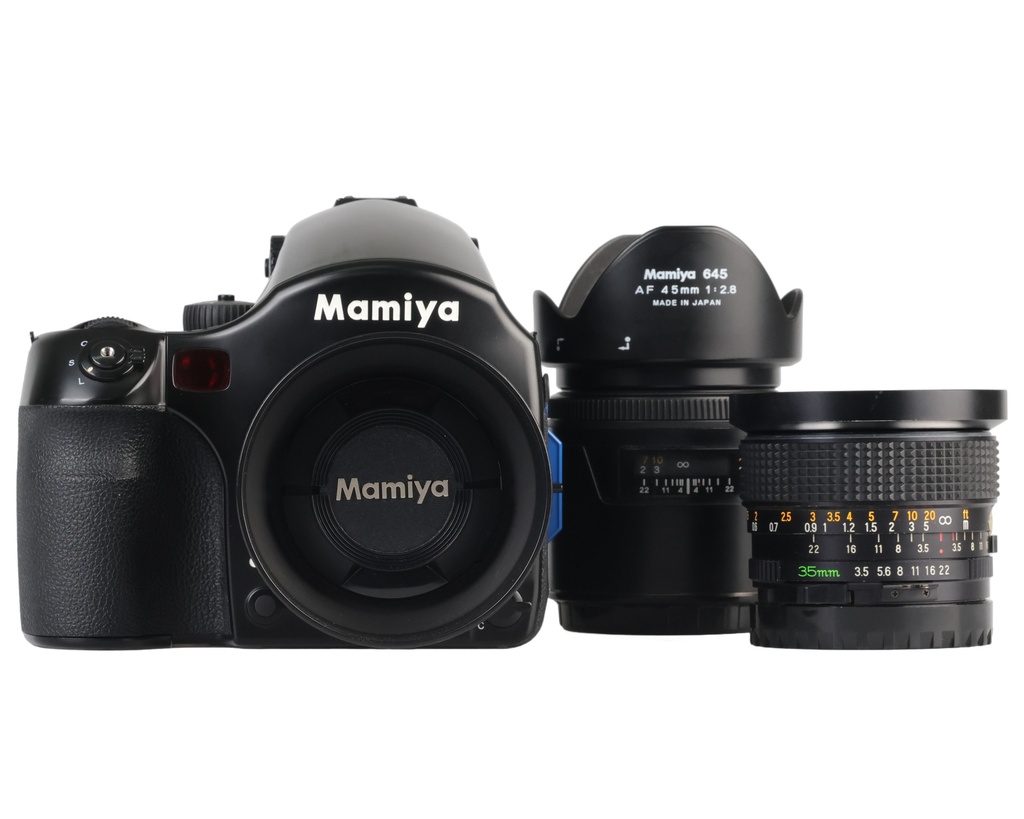
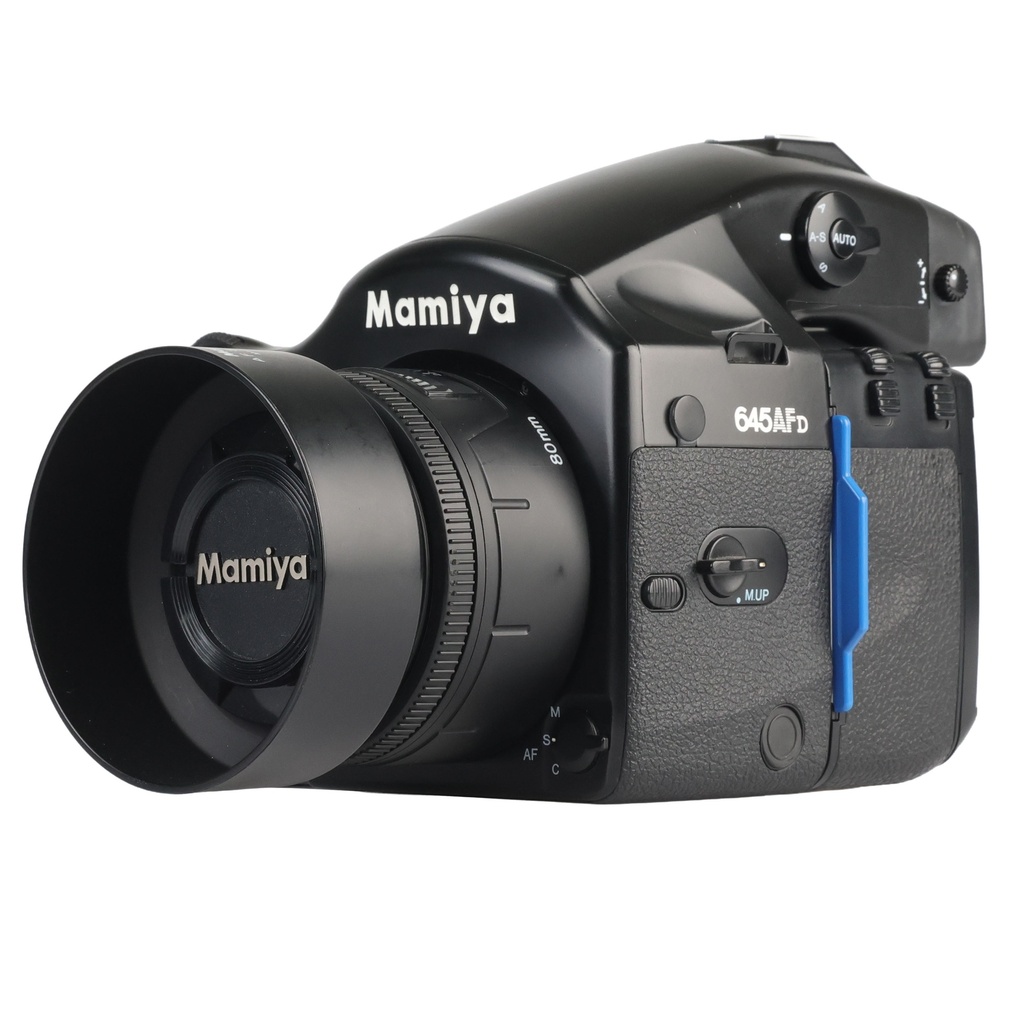
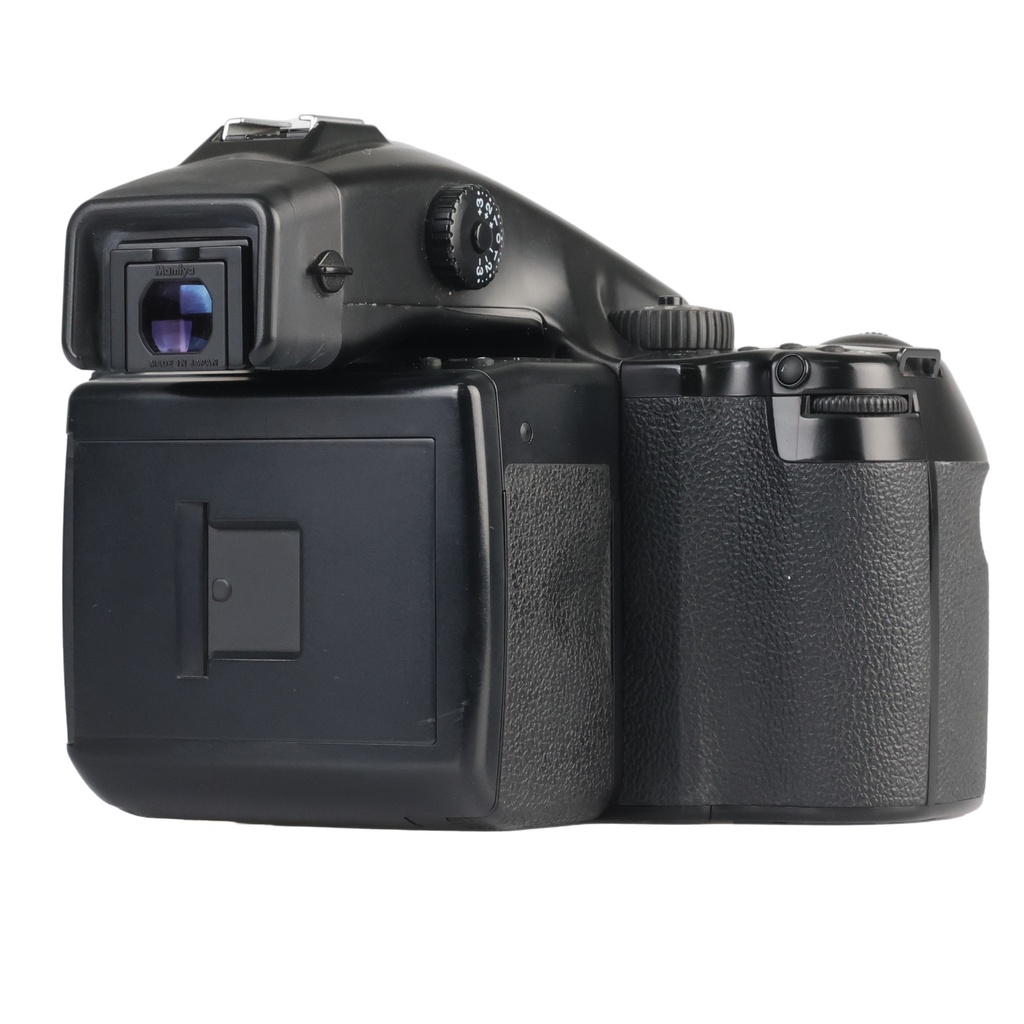
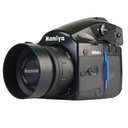
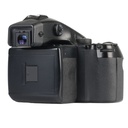
Many of the features of the 645 AFD are retained from Mamiya's previous series of 4.5x6cm SLR cameras (the M645 Super and related models). However, the camera is not built in the modular way that those cameras were; the power film winder is built-in, as is the AE prism viewfinder; a waist-level finder cannot be used (although there is a right-angle eyepiece attachment).
Metering
As in previous camera series, the prism finder has settings for spot (S) or center-weighted average (A) metering, and a setting (A-S) in which the camera automatically selects one or other of these, or an exposure between the two, based on the variation in brightness in the scene. The meter measures between EV 2 (1/2 second at f/2.8) and EV 19 (1/1000 second at f/22) at ISO 100, and allows exposure compensation by up to three stops in either direction; any selected compensation is shown in the VF display. The viewfinder eyepiece has a shutter to keep out light when the camera is used away from the eye, and built-in diotric adjustment.
Exposure settings
Exposure settings are controlled via menu options displayed in an LCD on top of the winder grip, and selected with wheel controls (one by the shutter release button, and another at the back of the grip, by the user's thumb) in combination with a main mode dial. The exposure settings in use are also displayed at the bottom of the viewfinder. The mode dial has settings for programmed AE (P), aperture-priority (Av) and shutter-speed priority (Tv) AE, metered manual exposure (M), auto flash (X) and a setting for long exposures (T). The dial locks in the 'X' mode; there is a lock-release button in the centre of the dial which must be pressed to move it from 'X' to any other mode.
Programmed AE ('P'). In this mode the camera selects both the shutter speed and aperture according to a programmed profile (that is, for any EV level, this mode offers a single combination of shutter speed and aperture; for example, at EV 12, 'P' mode gives 1/125 second at f/5.6). It is possible to shift the program profile to favour a shutter speed one stop lower, with a correspondingly smaller aperture giving the same EV (sub-mode PL, giving in the example above 1/60 second at f/8), or a higher speed and wider aperture (sub-mode PH, in the example case giving 1/250 second at f/4). These 'program shift' sub-modes are selected with either the front or rear wheel controls.
Aperture-priority AE ('AV'). In this mode, either wheel control is used to adjust the aperture, in half-stop increments. The LCD shows both the aperture and the shutter speed (or a flash symbol if the light cannot be metered at the selected aperture).
Shutter-priority AE ('TV'). In this mode the wheel controls are used to select the shutter speed, in half-stop increments. The LCD shows the speed and aperture; the aperture flashes if the light is too dim to meter at the selected shutter speed.
Metered manual ('M'). In this mode the front wheel control selects the shutter speed, and the rear control the aperture. Both are shown in the LCD. If the meter reading differs from the set values, the 'error' is shown at the right hand side of the viewfinder display, as the number of EV stops (up to ±6), in steps of one third of a stop (that is, if the VF display shows '+1.3', the current settings will give one and one third of a stop over-exposure, relative to the meter reading).
Flash ('X'). In this mode the shutter speed is fixed at 1/125 second.
Time ('T'). This mode allows 'T' shutter mode for very long exposures, where the shutter release is pressed once to open the shutter, and again to close it. In this mode, the shutter is mechanically controlled, so that the batteries are not drained by prolonged operation of the electronic shutter mechanism.
There is an AE lock button ('AEL') by the rear wheel control, allowing the user to reframe the scene after metering, in any of the AE modes. This is also useful to allow the AE modes to be used with the mirror-up control.
The wheel controls can be locked, using the 'F1' and 'SET' buttons by the LCD, to prevent accidental adjustment of the exposure settings in the AV, TV and M modes.
Advanced exposure functions
Exposure bracketing. In the P, TV and AV modes, exposure bracketing is available, selected by pressing the 'Mode' button by the Mode dial, once. The bracket can be adjusted to half, two-thirds or a whole stop, using either of the wheel controls.
Multiple exposure. The camera can be set to make up to five exposures before advancing the film. This facility is also selected by pressing the 'Mode' button twice, and the number of exposures on one frame adjusted with the wheel controls.
Self-timer. The self-timer is selected by pressing the 'Mode' button three times, and can be adjusted between 3 and 60 seconds, using either of the wheel controls.
Shutter
The camera has a focal-plane shutter with aluminium blinds that travel vertically. This gives speeds from 30 seconds to 1/4000 second, in steps of one-eighth of a stop when in AE, or half a stop when manually set. 'B' is available as a shutter speed in the 'M' mode, and there is a mechanically-controlled 'T' mode for very long exposures, as noted above. The shutter synchronises for flash at 1/125 second. Both shutter blinds are automatically retracted (i.e. the shutter opens) when the film back is removed (to avoid damage to them) or when there are no batteries in the camera.
The shutter release button has settings for single or continuous exposures, and a locked position. It is threaded for a standard cable release. There is also a socket on the left side of the body for electronic releases, including remote ones.
Focusing
The camera uses a through-the-lens phase-difference detection auto-focus method. The focus mode switch, which sets the behaviour of the auto-focus function, is on the front of the body, on the bottom left (i.e. the user's left when behind the camera; the side opposite the grip). There are three settings:
Single-focus ('S'). In this mode, when the shutter release is half-pressed, the camera focuses, using the area in the small rectangle marked across the centre of the VF. When satisfactory focus is achieved, the focus is fixed (i.e. the camera stops adjusting it), and the focus marker in the VF display lights. The shutter will not release until the marker has lit. Mamiya also describe this mode as focus priority, and suitable for still subjects. The fixed focus is cancelled if pressure is removed from the release button. This mode allows the familiar method in which the scane may be reframed after focusing, while holding the shutter release button down, to place the focused subject off-centre in the frame.
Continuous focus ('C'). In this mode, when the release button is half-pressed, the camera continuously adjusts the focus as the scene is reframed by the user. The focus mark lights when the current scene has been focused, but the shutter may be released at any time. Mamiya describe this mode as release priority, and suitable for moving subjects.
Manual focus ('M'). In this mode, focusing is done by the user with the lens' focus ring. The VF shows focus guidance arrows in addition to the focus marker (these only work with lenses of f/5.6 or wider).
The camera has an infra-red lamp on the front of the body, next to the shutter release. This lights to illuminate the subject in conditions of dim light or low subject contrast in the Single focus mode, to assist the auto-focus function.
There is a depth-of-field preview button on the bottom right of the front of the body.
Film holders
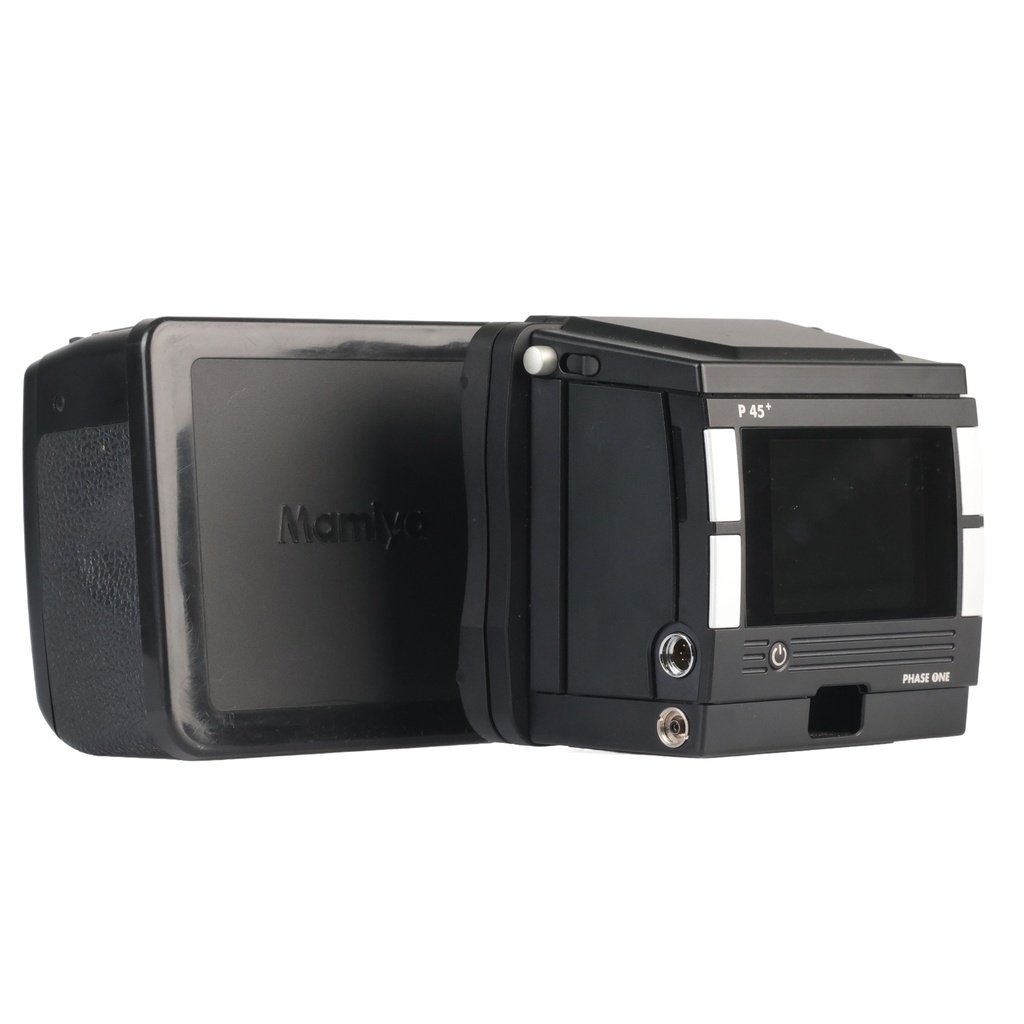
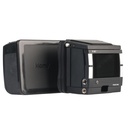
The 120 film back for the 645 AF is superficially similar to that for the earlier M645 Super; it is a detachable chamber, with a metal dark slide, into which a film insert (comprising a pair of spool-holders with a pressure plate and rollers) can be fitted. However, the back for the 645 AF has an LCD and 'up' and 'down' buttons to set and display the film type and speed (between ISO 25 and 6400), and requires its own battery (CR2032) to support this while the back is detached from the camera. It also has more electrical contacts than the earlier film back, and the two are not interchangeable. The same film insert accepts both 120 and 220 roll film; the pressure plate may be rotated, to adjust it for the different thickness of 120 and 220 film. The back automatically advances the film to frame 1 provided the paper leader is attached to the take-up spool. A Polaroid back also exists.
In addition to the automatic retraction of the shutter blinds, the camera has the same common-sense interlocks as the Super to prevent accidental exposure of film:
The dark slide cannot be opened when the back is off the camera.
The back cannot be detached when the dark slide is out.
The shutter cannot be released when the dark slide is in.
Other features
As with earlier models, the camera has a ⅜-inch tripod socket with an insert to adjust it to ¼-inch size.
There is a mirror-up lever on the left-hand side of the body.
There is a hot shoe on top of the prism, as well as a PC socket on the left side. The camera is compatible with some Metz flashes for through-the-lens flash metering, with an adapter.
There is a backlight for the LCD, switched on with the 'BL' button.
The camera has a built-in facility to imprint date and/or serial number data at the edge of each exposure. This is controlled with the 'F1', 'F2' and 'SET' buttons by the LCD.
The camera requires six AA alkaline or lithium batteries, which are loaded in a removable holder that fits into the grip. The LCD display shows the battery condition continuously when the camera is switched on (i.e. when the shutter release is not in the locked position).
An external battery holder exists (to be kept in a pocket, for cold-weather use); this connects to a socket in the base of the camera.
Lenses
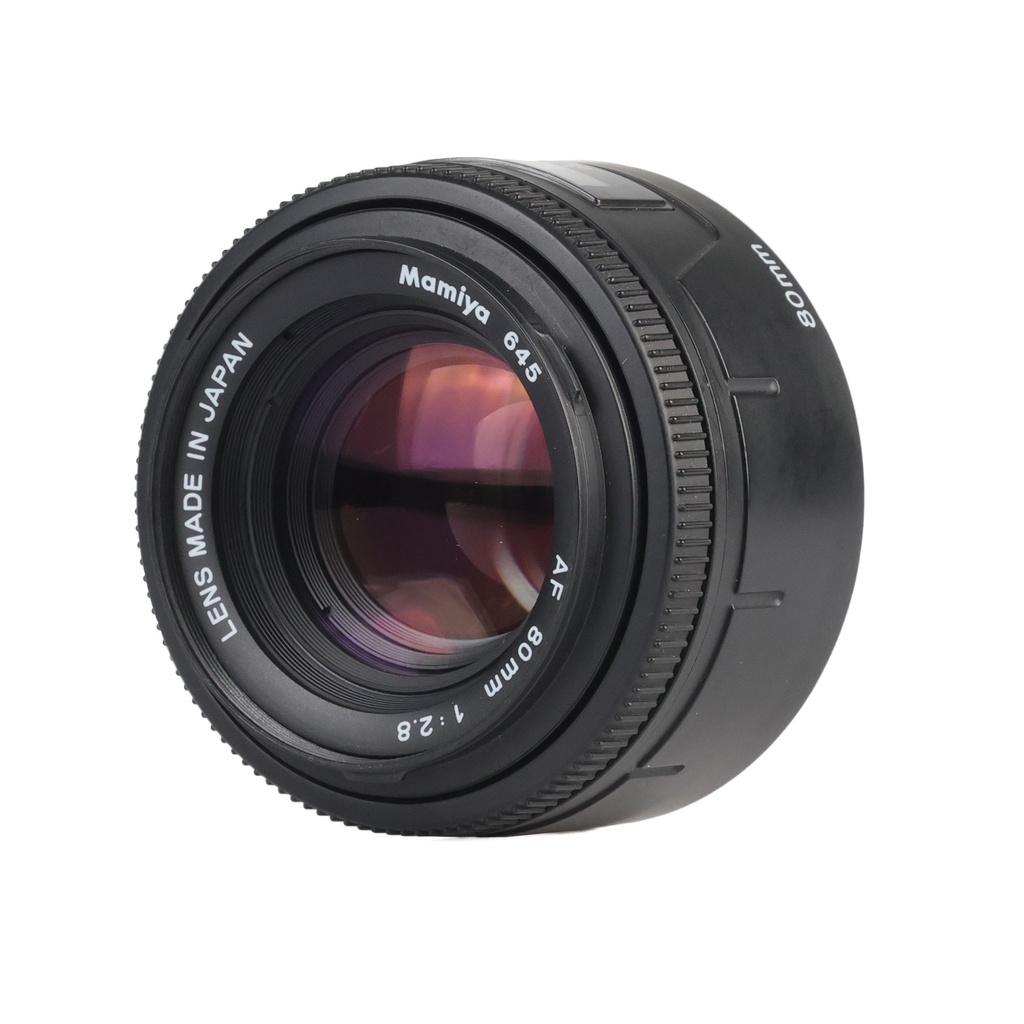
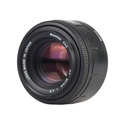
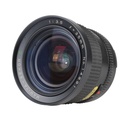
The standard lens is an 80 mm f/2.8
Other compatible lenses
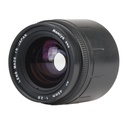
Sekor AF 28mm f/4.5 D aspherical
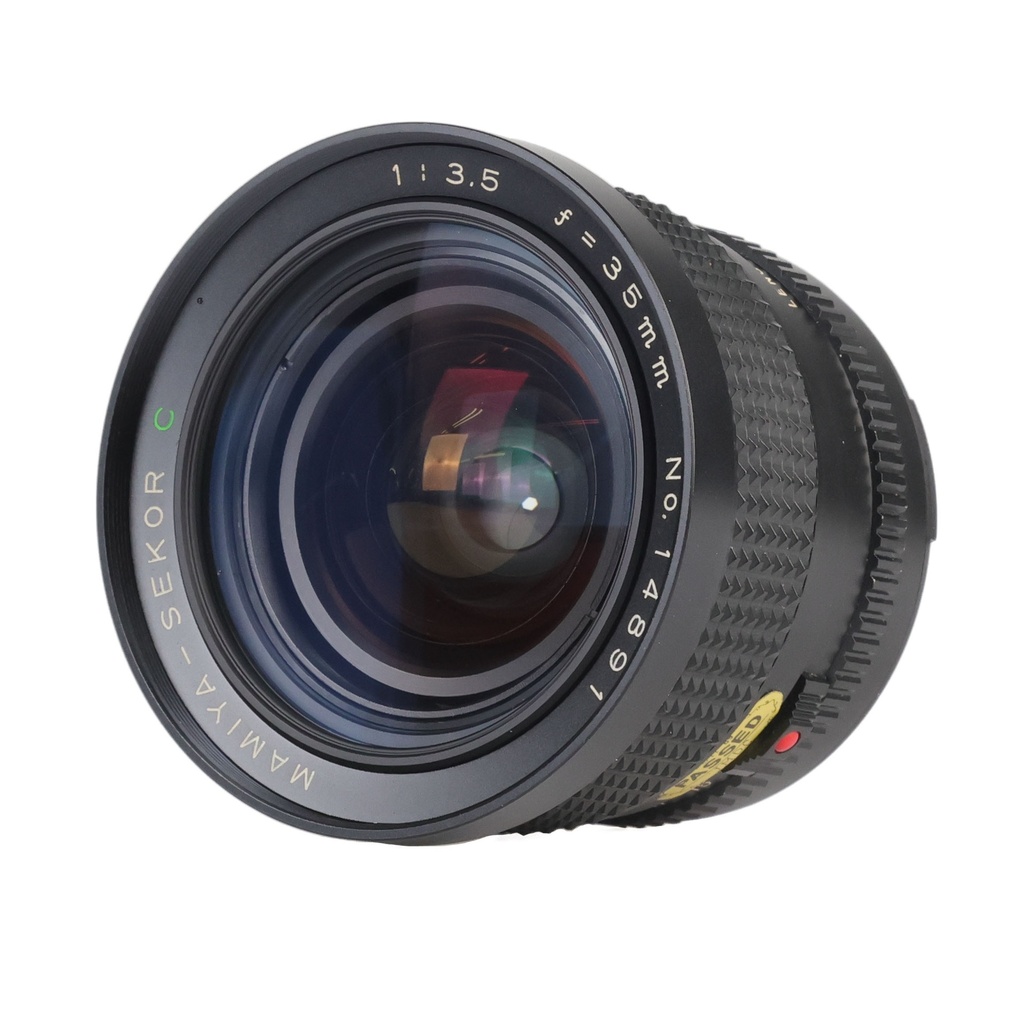
AF 35mm f/3.5
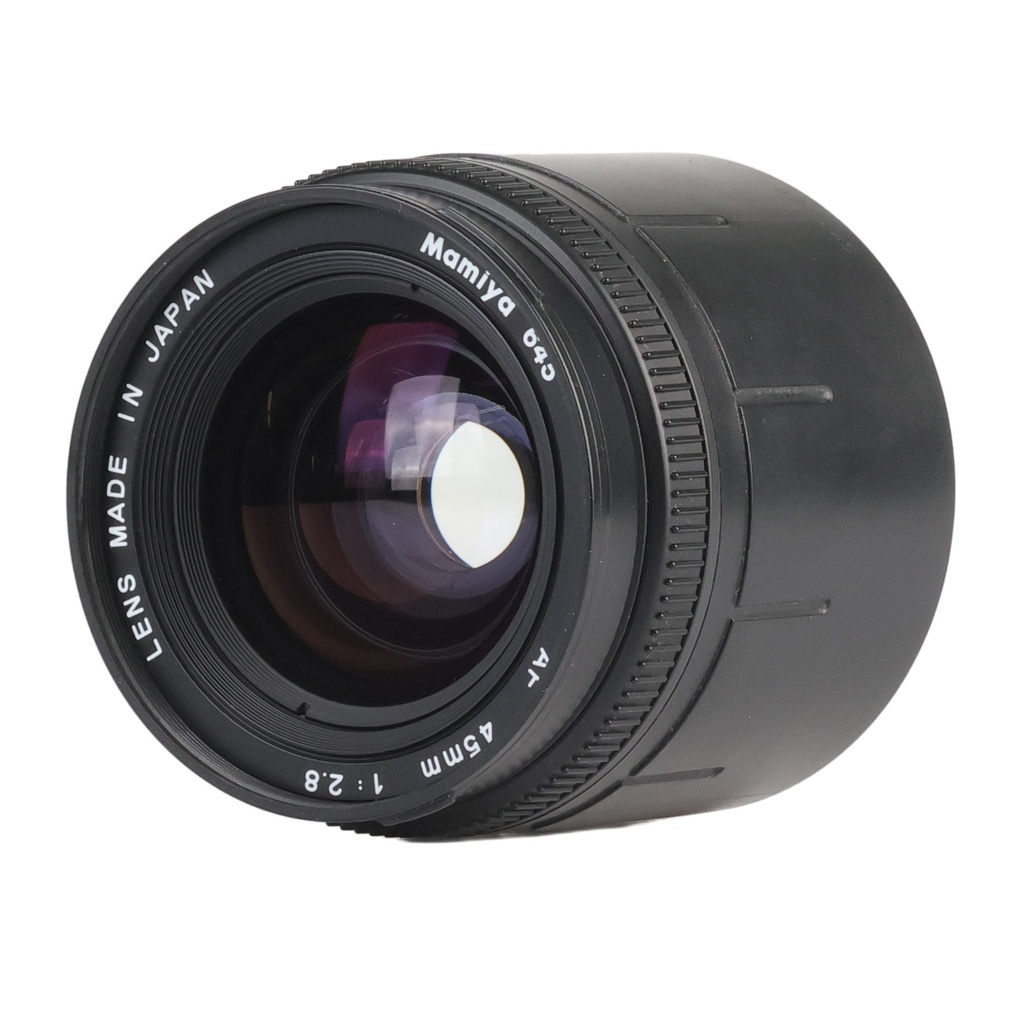
AF 45mm f/2.8
AF 55mm f/2.8
AF 80mm f/2.8
Sekor 80mm f/2.8 D
Sekor Macro MF 120mm f/4 D (manual focus only)
AF 150mm f/3.5
Sekor AF 150mm f/2.8 IF D
AF ULD[3] 210mm f/4 IF
AF APO 300mm f/4.5 IF
Zoom AF 55-110mm f/4.5
Sekor Zoom AF 75-150mm f/4.5 D
Zoom AF ULD[3] 105-210mm f/4.5
The range of designations is very similar to that provided for earlier generations of Mamiya 4.5×6cm SLRs, except for the addition of the 28mm.
The lenses attach on the AFD bayonet mount in the same way as with the previous mount, by aligning the lens with the red spot on the body and twisting to fasten the bayonet. The release is also unchanged; a sliding button on the left side of the camera body. The AF mount is compatible, in a limited way, with the lenses for the preceding models (the Mamiya M645 and M645 Super/Pro series cameras). The manual-focus lenses can be fitted to the new mount, but the AF cameras do not have the pin to mate with the aperture yoke on these lenses, so stopped-down metering must be used. There is also a special focusing screen, with a manual-focusing aid (a microprism/rangefinder spot) for use with manual lenses.
Mamiya produce a mount adapter allowing the use of Hasselblad V series lenses. These are subject to similar limitations, needing the manual-focus screen and stopped-down metering.