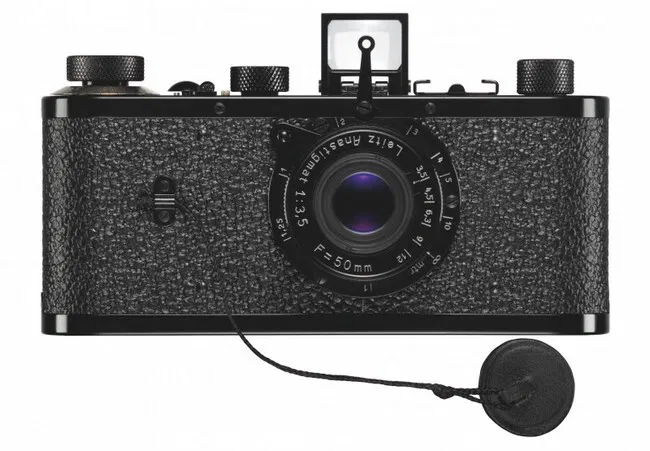
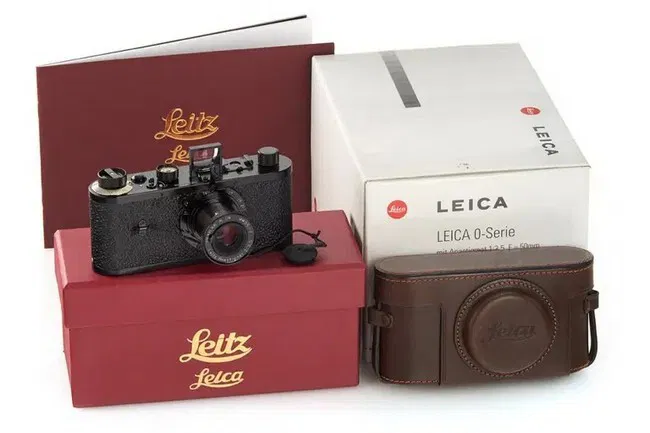
During a voyage to the past, we come upon an event that made history: Oskar Barnack was searching for a way to make cameras more compact and more versatile, so that he and other photographers would not have to carry along the usual bulky plate cameras. Pursuing his intention of a “small negative – large picture”, he experimented and eventually settled on the idea of doubling the motion picture format, the format that is still in worldwide use to this day. To use that format, he built the very first 35-mm camera from Leitz: the legendary “Ur-Leica” of 1913/14. In 1923/24, this evolved into a small series of probably 25 improved prototypes – the so-called “0-Series”, extremely rare today, and eagerly coveted by collectors.
Leitz (a short version of the company’s name at that time: the name “Leica” was created later from the words “Leitz” and “camera”) used these prototypes in an early version of market research. Unfortunately the results were discouraging: photographers were not impressed and they did not recognize the new possibilities. The decision to proceed with the production of the camera in spite of their reaction was rewarded by great success. The pioneering Leica innovations of those early years established standards in camera technology that enabled great photographers to make dramatic pictures that continue to influence our view of the world today.
A challenge for creative photographers. There are more than enough reasons for the LEICA 0-SERIES to be born again. Our intention was to enable imaginative photographers to explore, in their own personal way, entirely new creative challenges; because it is a very special experience to develop a new feeling for photography with this classic camera.
Lavish manufacture. “As original as possible, as modern as necessary” – the thought that became the guideline for the new edition of the LEICA 0-SERIES camera. When you handle this camera for the very first time and examine all its aspects, you will definitely be fascinated. First of all because of the authenticity of the camera, which is faithfully true to the original in terms of dimensions, shape, surfaces, engravings and materials. Second, because of its high optical and mechanical precision, just as it was in the original. Third, of course, because this camera accepts conventional 35-mm film cartridges. Thus it is not just a collector’s item, but a genuine tool as well, with which photography presents itself in an entirely new way.
Love of detail. After taking it out of its case, the camera fits the hand pleasantly and securely. Like the original, the camera body is covered with durable artificial leatherette. Experts will be pleased right away by the typical black lacquer finish of external brass components like the top plate, baseplate, knurled knobs, and lens mount. The first look through the viewfinder, which consists of a fold-down lens and a fold-down sight, reveals another pleasing detail (other than the subject): a cross hair etched on the plane side of the viewfinder lens.
TYPE: 35 mm viewfinder camera with a mechanically controlled focal plane shutter and a non-interchangeable lens.
FILM FORMAT: 24 mm x 36 mm.
DIMENSIONS: Height 65 mm (with the viewfinder folded down), Width 133 mm, Depth 39 mm (with the lens collapsed).
WEIGHT: 430 g (15.2 oz).
BODY: Extruded aluminum covered with artificial leather covering. Interior shell of deep-drawn brass.
LENS: Leitz Anastigmat 50 mm f/3.5. Non-interchangeable, 4 lens elements in 3 groups.
SHUTTER: Horizontal mechanically controlled rubberized cloth focal plane shutter. Exposure times: "B", 1/20, 1/50, 1/100, 1/200, 1/500 sec.
TRIPOD SOCKET: A 1/4 inch, DIN 4503.
Fascinating technology. True as it is to the original, the selection of exposure times is unconventional by today’s standards. In order to set an exposure time, the slit of the focal plane shutter is adjusted to a specific width. A slit width of 1 mm corresponds to approximately 1/1000 second. The camera is calibrated for exposure times of “B”, 1/20, 1/50, 1/100, 1/200 and 1/500 second. When the shutter is completely wound after an exposure, the film is advanced by one 24 mm x 36 mm frame – easy to follow by means of the exposure counter dial, which is engraved with black inlaid numbers at every 5th calibration line to indicate the number of exposures that have been made. The exposure time selection, film loading on to a take-up spool and film rewinding are all faithful to the original. Another peculiarity is the coupled film advance and shutter winding: because the focal plane shutter, unlike the shutters in later models of the Leica, does not cap itself during the winding step, the small leather lens cap has to be inserted into the front of the lens in order to protect the film from being fogged.
Powerful optics. The lens construction is also faithful to the original – a Leitz Anastigmat 50 mm f/3.5 in a collapsible mount with a bayonet lock for the extended position. Its optical performance is comparable to that of the later Elmar 50 mm f/3.5, in fact it sometimes surpasses it. The aperture markings (3.5, 4.5, 6.3, 9 and 12), the stepless aperture adjustment and the distance settings (INFINITY, 10, 5, 4, 3, 2, 1.5, 1.25 and 1 m) were all executed in accordance with vintage specifications. A concession to present-day standards is the modern coating of the lens.
Allow yourself to be seduced. Will it ever really be possible to travel back in time? Right now, with the LEICA 0-SERIES we can at least take an interesting trip back into the past of photography. A trip that begins when you open the handsome case and start gathering extraordinary new experiences with historical photographic experiments.